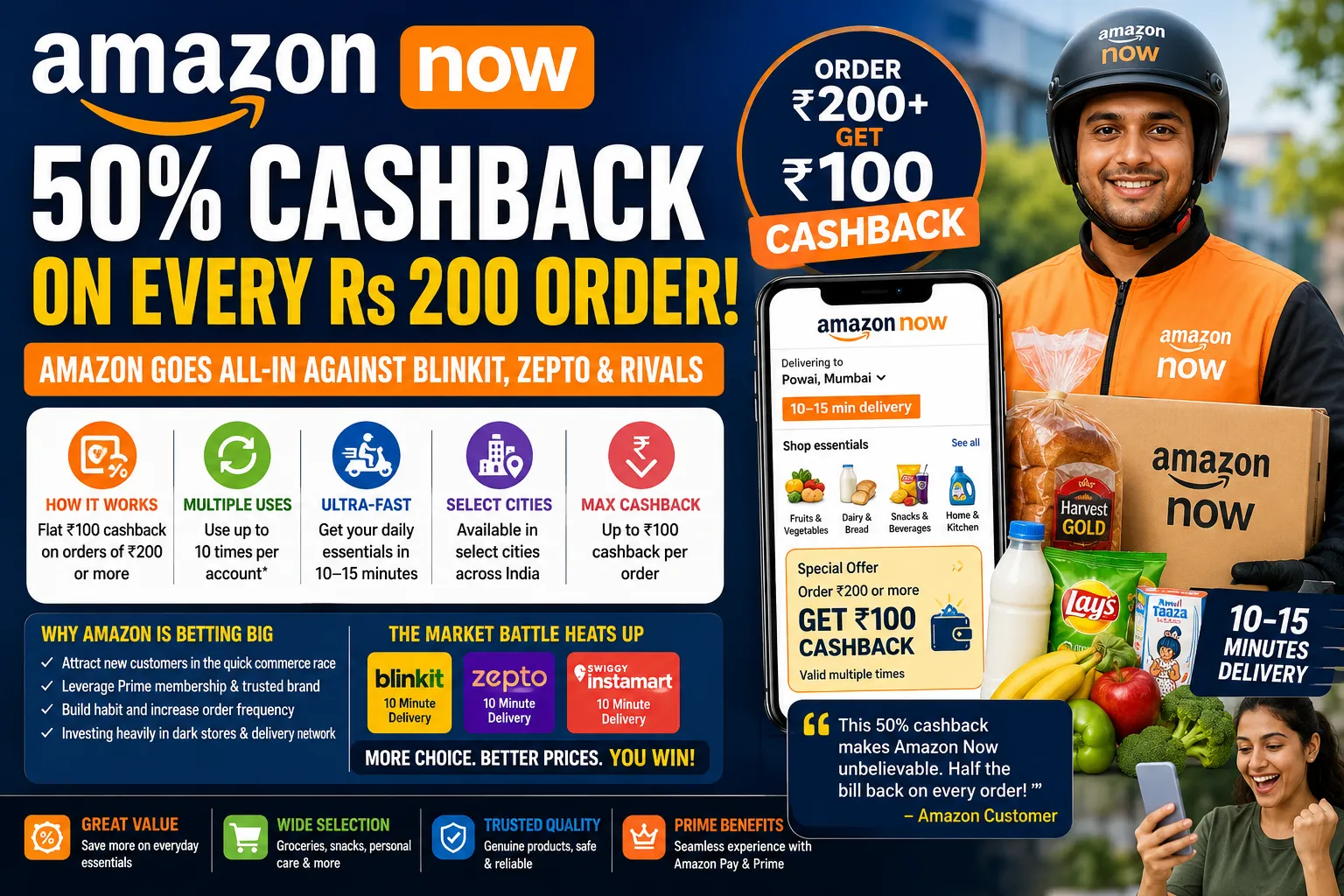
In a bold and eye-catching move that has sent ripples through India’s hyper-competitive quick commerce market, Amazon has launched what many customers are calling an “unbelievable” promotion: 50% cashback (up to Rs 100) on every order of Rs 200 and above through its ultra-fast delivery service, Amazon Now. This aggressive cashback strategy, effectively halving the bill on small grocery and daily essential orders, signals Amazon’s serious intent to catch up in a sector long dominated by specialists like Blinkit, Zepto, and Swiggy Instamart.
While Amazon was relatively late to the 10-15 minute delivery game, the e-commerce giant is now leveraging its massive scale, Prime membership base, and deep pockets to disrupt the status quo. The new offer has quickly become a talking point among consumers, with many questioning whether it is sustainable or simply a short-term customer acquisition tactic.
Understanding the Offer
Under the current promotion, customers placing an order of Rs 200 or more on Amazon Now receive a flat Rs 100 cashback. This translates to exactly 50% back on a Rs 200 order. The cashback amount remains capped at Rs 100 even for higher order values (up to certain limits reported around Rs 1,400 in some cases), making it particularly attractive for frequent small-ticket purchases like milk, bread, snacks, fruits, vegetables, and household items.
Users have reported that the offer appears usable multiple times — sometimes up to 10 times per account — turning it into a powerful loyalty tool. For example, ten separate Rs 200 orders could theoretically yield Rs 1,000 in cashback, bringing the effective cost down to Rs 1,000 for Rs 2,000 worth of goods. The promotion is available in select cities where Amazon Now operates and is accessible via the Amazon app.
Why Amazon is Going All-In on Quick Commerce
India’s quick commerce sector has exploded in recent years, driven by changing urban lifestyles, smartphone penetration, and demand for instant gratification. Blinkit (backed by Zomato) currently leads with a significant market share, followed closely by Zepto and Swiggy Instamart. These platforms have built dense networks of dark stores, enabling deliveries in 10-15 minutes.
Amazon, traditionally strong in broader e-commerce with next-day or same-day delivery, entered the quick commerce space more cautiously. However, the company has been accelerating its expansion aggressively. It is rapidly scaling Amazon Now across major cities and plans further rollout. Reports suggest Amazon is investing hundreds of millions of dollars to strengthen its hyperlocal infrastructure, including dark stores and last-mile delivery capabilities.
The 50% cashback offer is a classic market penetration strategy. By absorbing a substantial portion of the order value as an acquisition cost, Amazon aims to:
-
Attract new users who are loyal to competitors
-
Encourage habit formation among existing Prime members
-
Increase order frequency and basket size over time
-
Gather valuable data on quick commerce consumer behaviour
Impact on Consumers and the Market
For customers, this promotion is a clear win in the short term. It makes daily essentials significantly more affordable, especially in inflationary times when household budgets are stretched. Many users are experimenting with Amazon Now for the first time purely because of the cashback, leading to positive word-of-mouth and social media buzz.
However, industry observers caution that such heavy discounting may not last indefinitely. Quick commerce is notorious for challenging unit economics — high operational costs related to rapid delivery, inventory management, and rider incentives often lead to losses. Amazon’s deep resources give it an advantage in sustaining losses longer than smaller players, but the goal remains achieving sustainable profitability.
The move has intensified the overall price war in the sector. Competitors are likely monitoring the response closely and may counter with their own promotions, free delivery offers, or expanded catalogs. This benefits consumers through better service, wider selection, and lower prices, at least in the near term.
Amazon’s Competitive Advantages
While Blinkit and Zepto pioneered the model, Amazon brings unique strengths to the table:
-
Huge Existing Customer Base: Millions of Prime members can be converted to quick commerce users with minimal additional marketing spend.
-
Integrated Ecosystem: Seamless integration with Amazon Pay, Prime benefits, and the main e-commerce platform creates a unified shopping experience.
-
Supply Chain Expertise: Amazon’s advanced logistics technology and vendor relationships can help optimize inventory and reduce stock-outs.
-
Brand Trust: Long-standing reputation for reliability and customer service provides an edge in a market where trust matters for food and grocery purchases.
Amazon Now also offers a wider product selection in some cases by leveraging its broader fulfillment network alongside dedicated quick commerce dark stores.
Challenges Ahead
Despite the strong start, Amazon faces steep challenges. Building a profitable quick commerce operation requires hyperlocal optimization, which takes time. Maintaining delivery speeds while scaling nationally is complex. Additionally, heavy cashback offers can attract deal-hunters rather than loyal customers, potentially leading to high churn once the promotion ends.
Regulatory scrutiny on deep discounting and competition issues in the broader e-commerce and grocery space could also play a role in shaping future strategies.
The Bigger Picture for Quick Commerce in India
The sector is projected to grow rapidly as more consumers shift from traditional kirana stores and standard e-commerce to instant delivery. Urban millennials and Gen Z, in particular, value convenience above all. As competition heats up, the focus is shifting from pure speed to a combination of speed, selection, reliability, and value.
Amazon’s aggressive entry validates the massive potential of quick commerce. It also raises the bar for innovation. Future success will likely depend on striking the right balance between growth and profitability, leveraging technology for efficiency, and building sustainable customer relationships beyond discounts.
For now, the 50% cashback offer on Amazon Now has successfully grabbed attention and forced the market to take notice. Whether this becomes a game-changing moment for Amazon or a costly but necessary investment remains to be seen. One thing is certain: Indian consumers are the biggest beneficiaries of this intensifying battle.
As Amazon Now expands its footprint and refines its model, the quick commerce landscape in India is set to become even more dynamic. For customers enjoying Rs 100 back on their Rs 200 grocery runs, the promotion feels almost too good to be true — but as many have already discovered, it is very real.
pressnbcnews pressnbcnews pressnbcnews pressnbcnews pressnbcnews pressnbcnews pressnbcnews pressnbcnews pressnbcnews pressnbcnews pressnbcnews pressnbcnews pressnbcnews pressnbcnews pressnbcnews pressnbcnews pressnbcnews pressnbcnews pressnbcnews pressnbcnews pressnbcnews pressnbcnews pressnbcnews pressnbcnews pressnbcnews pressnbcnews pressnbcnews pressnbcnews pressnbcnews pressnbcnews pressnbcnews pressnbcnews pressnbcnews pressnbcnews pressnbcnews pressnbcnews pressnbcnews pressnbcnews pressnbcnews pressnbcnews pressnbcnews pressnbcnews pressnbcnews pressnbcnews pressnbcnews pressnbcnews pressnbcnews pressnbcnews pressnbcnews pressnbcnews pressnbcnews pressnbcnews pressnbcnews pressnbcnews pressnbcnews pressnbcnews pressnbcnews pressnbcnews pressnbcnews pressnbcnews pressnbcnews pressnbcnews pressnbcnews pressnbcnews pressnbcnews pressnbcnews pressnbcnews pressnbcnews pressnbcnews pressnbcnews pressnbcnews pressnbcnews pressnbcnews pressnbcnews pressnbcnews pressnbcnews pressnbcnews pressnbcnews pressnbcnews pressnbcnews pressnbcnews pressnbcnews pressnbcnews pressnbcnews pressnbcnews pressnbcnews pressnbcnews pressnbcnews pressnbcnews pressnbcnews pressnbcnews pressnbcnews pressnbcnews pressnbcnews pressnbcnews pressnbcnews pressnbcnews pressnbcnews pressnbcnews pressnbcnews pressnbcnews pressnbcnews pressnbcnews pressnbcnews pressnbcnews pressnbcnews pressnbcnews pressnbcnews pressnbcnews pressnbcnews pressnbcnews pressnbcnews pressnbcnews pressnbcnews pressnbcnews pressnbcnews pressnbcnews pressnbcnews pressnbcnews pressnbcnews pressnbcnews pressnbcnews pressnbcnews pressnbcnews pressnbcnews pressnbcnews pressnbcnews pressnbcnews pressnbcnews pressnbcnews pressnbcnews pressnbcnews pressnbcnews pressnbcnews pressnbcnews pressnbcnews pressnbcnews pressnbcnews pressnbcnews pressnbcnews pressnbcnews pressnbcnews pressnbcnews pressnbcnews pressnbcnews pressnbcnews pressnbcnews pressnbcnews pressnbcnews pressnbcnews pressnbcnews pressnbcnews pressnbcnews pressnbcnews pressnbcnews pressnbcnews pressnbcnews pressnbcnews pressnbcnews pressnbcnews pressnbcnews pressnbcnews pressnbcnews pressnbcnews pressnbcnews pressnbcnews pressnbcnews